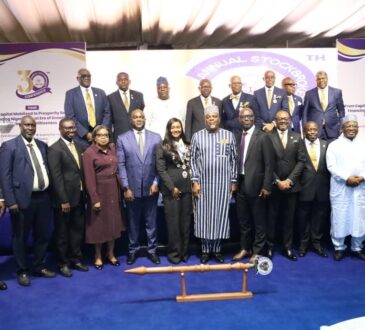
CIS 30th Annual Conference: Turning Capital Mobilisation into Prosperity, By Sola Oni

For Nigeria, the question is no longer whether capital can be raised. The bigger question is whether the capital raised can deliver prosperity. At a time when the country faces enormous financing requirements across infrastructure, energy, industry, technology and other productive sectors, the ability to mobilise and efficiently deploy long-term capital has become central to the nation’s economic future. Against this backdrop, the Chartered Institute of Stockbrokers’ 30th Annual Conference comes at a defining moment.
Nigeria stands at a critical financing crossroads. With vast investment needs across infrastructure, industry, energy, technology and other productive sectors, the country must determine how to mobilise long-term capital and, more importantly, how to deploy it efficiently to generate sustainable economic growth. It is against this backdrop that the Chartered Institute of Stockbrokers’ 30th Annual Conference assumes strategic significance.
Scheduled for November 4–5, 2026, at Harbour Point, Lagos, the landmark conference will bring together stockbrokers, policymakers, investors, regulators and other key stakeholders under the theme, “From Capital Mobilised to Prosperity Realised: Financing Nigeria’s Next Era of Growth and Global Competitiveness.”
The theme could hardly be more relevant. Nigeria has demonstrated considerable capacity to mobilise capital through its financial markets, but the more important question is what happens after the funds are raised. Does capital translate into expanded productive capacity, stronger businesses, infrastructure development, employment, innovation and improved economic competitiveness?
This is the conversation the CIS conference under the leadership of the 14th President and Chairman of Council, Dr Fiona Ahimie and her colleagues, the Principal Officers of the Institute should place firmly on the national agenda.
For an economy confronting significant financing requirements, the capital market cannot remain simply a platform for transactions. It must increasingly serve as an engine for mobilising long-term savings and directing them towards productive investment.
Government alone cannot provide the financing required to address Nigeria’s infrastructure deficit, support industrial expansion, develop new technologies, expand energy capacity and finance businesses with the potential to compete globally. Domestic and international private capital must therefore become an increasingly important component of the country’s growth strategy.
Investors require credible markets, effective regulation, transparency, strong corporate governance and adequate protection. Companies seeking funding need access to patient capital and a market capable of matching their financing needs with appropriate investment opportunities.
The conference therefore provides an important platform to examine how Nigeria can deepen its capital market while making it more attractive to both domestic and international investors.
A key issue should be the mobilisation of domestic savings. Nigeria has substantial pools of institutional and private savings, yet the challenge is to channel more of these resources into long-term productive investment without compromising liquidity, security and investor confidence.
The role of the stockbroker must also come under renewed examination. Technology is transforming the financial-services industry, changing how investors access information, execute transactions and manage portfolios. But technology does not eliminate the need for professional judgement, market knowledge, investor education and adherence to ethical standards.
Indeed, the changing environment creates an opportunity for stockbrokers to reposition themselves as strategic participants in capital formation, helping businesses understand financing alternatives, connecting issuers with investors and contributing to the efficient allocation of capital.
The question is how the profession can remain indispensable as Nigeria’s financial system becomes increasingly digital and sophisticated.
The conference should equally examine Nigeria’s ambition for global competitiveness. Attracting foreign capital is important, but the longer-term objective should be to build Nigerian companies capable of competing for capital and markets globally. That requires scale, innovation, productivity, sound governance and access to appropriate long-term financing. The capital market can provide an important part of that financing architecture.
The 30th Annual Conference is therefore significant not only because it marks three decades of the CIS bringing professionals and stakeholders together, but because it provides an opportunity to look ahead. What should Nigeria’s capital market look like over the next decade? What reforms are necessary to deepen liquidity and market participation? How can investor confidence be strengthened? What can be done to increase the number and quality of listed companies? How can the market finance infrastructure and productive enterprises more effectively? And how can stockbrokers position themselves at the centre of Nigeria’s next phase of economic transformation?
These questions make the conference more than an industry event. They make it a platform for shaping a broader national conversation about the relationship between finance and development. The ultimate measure of capital-market success should not be the amount of money raised alone. It should also be the economic value generated from that capital.
Capital mobilised should finance productive assets. Productive assets should generate growth. Growth should create jobs, expand businesses, strengthen government revenues and improve the capacity of Nigerian companies to compete.
That is the journey from capital mobilised to prosperity realised. As the CIS celebrates its 30th Annual Conference, the occasion offers an important opportunity for the profession and the wider financial community to confront this challenge collectively. The conference can help move the conversation from the size of transactions to their impact, from capital raised to value created, and from financial-market activity to sustainable economic outcomes.
For Nigeria, that is a conversation worth having and one whose outcome could shape the role of the capital market in financing the country’s next era of growth and global competitiveness.
Oni, an Integrated Communications Strategist, Chartered Stockbroker, Commodities Broker and Capital Market Registrar, is the Chief Executive Officer, Sofunix Investment and Communications

About The Author

Vitafoam Invests in Health and Humanity with Equipment Donation to UPTH

ICMR Seeks Stronger Institutions, Technology-Driven Capital Market Beyond Recapitalisation

NGX Group Acquires 10% Stake in Nairobi Exchange, Deepens Pan-African Expansion