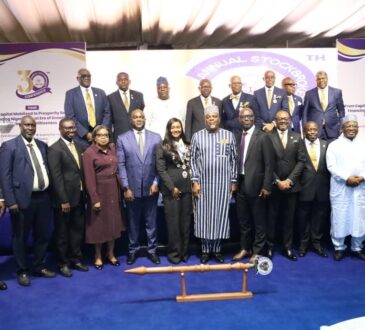
CIS Seeks Stronger Link Between Capital Mobilisation and Economic Growth- Bashir

Saheed Bashir, Chairman of the Conference Committee, Chartered Institute of Stockbrokers (CIS) speaks on the Institute’s advocacy for a stronger connection between Nigeria’s capital market and the real economy ahead of the 30th Annual Stockbrokers’ Conference, scheduled for November 4–5, 2026, at Harbour Point, Victoria Island, Lagos.
What is the central message behind the theme of the 30th Annual Stockbrokers’ Conference, “From Capital Mobilised to Prosperity Realised”?
The central message is that capital mobilisation should not be regarded as an end in itself. Nigeria has demonstrated that its capital market can mobilise substantial funds, but the more important question is what those funds ultimately achieve in the real economy. We want to move the conversation from simply asking how much capital was raised to asking what that capital is building, how many jobs it is creating, how much productive capacity it is adding, what infrastructure it is financing and how it is improving household wealth. A rising market capitalisation or stock-market index is encouraging, but it does not automatically translate into a higher standard of living. Our objective is therefore to promote a stronger transmission mechanism between the capital market and the real economy.
You have spoken about the need to strengthen the link between capital mobilisation and economic growth. What exactly is missing in Nigeria’s current capital-market system?
The missing element is a stronger and more deliberate transmission mechanism between capital raised and productive economic activity. Raising capital is only the first stage. We need to ensure that funds are channelled into investments that expand productive capacity, create jobs, improve infrastructure and generate sustainable economic value. We also need to measure the impact of capital-market activities by looking beyond market capitalisation and transaction volumes to indicators such as employment, industrial output, SME financing and household wealth.
What specific steps does the CIS want to see to create a stronger connection between capital mobilisation and Nigeria’s economic growth?
We want a more deliberate alignment between the capital market and national development priorities. Capital should increasingly be mobilised towards sectors such as infrastructure, manufacturing, agriculture, housing, energy and SMEs. We also need to deepen long-term domestic savings by encouraging pension funds, insurance companies and other institutional investors to invest in productive assets and long-term instruments. At the same time, government must maintain policies that promote macroeconomic stability and investor confidence. Most importantly, we need to change the way we define success. The question should no longer be only, “How much capital did we raise?” but also, “What did that capital achieve?” If the answer is more jobs, higher production, better infrastructure and greater household wealth, then we can truly say that capital mobilisation has translated into economic growth and prosperity.
Nigeria’s market capitalisation has grown significantly, while major transactions such as the Dangote Refinery IPO are attracting unprecedented capital. Why is the CIS still concerned about translating capital mobilisation into prosperity?
We are not concerned in the sense of being pessimistic about the market. Rather, we see the growth of the market as an opportunity to demand more from it. The growth in market capitalisation and landmark transactions such as the Dangote Refinery IPO demonstrate that investors have confidence in the potential of Nigeria’s capital market. But capital is most valuable when it is deployed productively. The Dangote transaction, for example, provides an important illustration because it is a primary issuance designed to support the expansion of productive capacity. Its success should therefore be measured not only by the amount raised but also by what the investment contributes to refining capacity, employment, industrialisation and the wider economy. That is the thinking behind “From Capital Mobilised to Prosperity Realised.”
What should government and regulators do differently to enable the capital market to play a bigger role in Nigeria’s economic development?
Government and regulators have a critical role in creating an environment in which long-term capital can flourish. We need consistent and predictable policies, effective regulation, strong investor protection and greater confidence in the investment environment. The regulatory framework must continue to evolve with technology and changing global market practices.Government should also increasingly view the capital market as a strategic instrument for financing development rather than simply as a platform for buying and selling securities.There should be stronger coordination among government, the SEC, CBN, PenCom, NAICOM, exchanges and market intermediaries to develop products capable of financing infrastructure, housing, energy, manufacturing and other productive sectors.
What strategic role should stockbrokers play in Nigeria’s economic development beyond executing buying and selling of securities?
The role of the stockbroker today is much broader than executing transactions. Stockbrokers are mobilisers and allocators of capital. They connect investors who have surplus funds with businesses and governments that require long-term capital. In doing so, they influence where capital goes and, ultimately, what gets built in the economy.Stockbrokers must therefore understand the businesses they advise, undertake quality research and direct investors towards productive opportunities. They should also help companies access the capital market appropriately, improve their governance and communicate effectively with investors.If Nigeria wants to move from capital mobilisation to economic transformation, stockbrokers must see themselves as partners in national economic development, not merely as market operators.
How can Nigerian stockbrokers help attract more domestic and foreign investment into the country?
Stockbrokers are the front door to the capital market and, in many cases, the first professional representatives investors encounter. They must therefore provide international-quality service, credible research, transparent advice and efficient execution. Technology is also critical. Investors increasingly expect seamless digital onboarding, reliable trading platforms, strong cybersecurity and timely information. Stockbrokers also have an important role in engaging Nigerians in the diaspora and foreign investors who want exposure to Nigerian opportunities. Investors need three things: returns, access,and trust. Stockbrokers contribute significantly to all three.
What strategic role does the Chartered Institute of Stockbrokers play in Nigeria’s economic development?
The Institute’s role goes beyond certifying professionals. As the professional body responsible for setting standards for stockbroking, the CIS has a responsibility to ensure that its members at different levels operate with the highest standards of competence, ethics and professionalism. We are therefore building professionals who can understand complex financial products, global investment trends, sustainability issues, technology and the changing needs of investors. The Institute also has a responsibility to contribute to national policy conversations. Through research, conferences, professional development and engagement with regulators and policymakers, we can help shape a capital market that supports Nigeria’s long-term development. Our vision should be to produce stockbrokers who are not merely technically competent, but who understand how capital can be used to transform an economy.
As the CIS is set to hold its 30th Annual Conference, what should be the profession’s strategic priorities for the next 30 years?
The next 30 years must be about relevance, innovation and impact. First is professional excellence and ethics. Investor confidence depends heavily on the integrity of market professionals. Second is technology. Stockbroking must embrace digital platforms, artificial intelligence, data analytics and cybersecurity while maintaining appropriate safeguards.Third is financial inclusion. We must bring more Nigerians into the investment ecosystem through financial literacy, digital access and innovative products. Fourth is global competitiveness. Nigerian stockbrokers must be able to compete for international capital and meet global standards of research, governance and service delivery. And finally, we must remain focused on the real economy. The profession should constantly ask: What difference is the capital market making to Nigeria’s development?
What do you expect Nigerians to take away from the 30th Annual Stockbrokers’ Conference?
I expect the conference to produce more than speeches and deliberations. We want concrete recommendations that can influence policy and market development. We expect discussions around how Nigeria can better connect capital mobilisation with productive investment, how to increase retail participation, how to deepen institutional investment and how to strengthen the pipeline of quality listings. We also want to examine the lessons from landmark transactions such as the Dangote Refinery IPO and determine how the market can replicate successful capital-raising models. Most importantly, we want to reinforce a new mindset within theprofession: the success of Nigeria’s capital market should ultimately be measured by the prosperity it helps create.That is the essence of our theme from capital mobilised to prosperity realised.

About The Author


Vitafoam Invests in Health and Humanity with Equipment Donation to UPTH

ICMR Seeks Stronger Institutions, Technology-Driven Capital Market Beyond Recapitalisation

NGX Group Acquires 10% Stake in Nairobi Exchange, Deepens Pan-African Expansion