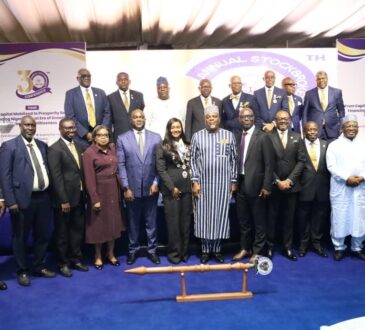
The Director General, Securities and Exchange Commission (SEC), Mr Lamido Yuguda, has stated that the ongoing efforts towards integration and harmonization would deepen West African capital markets, attract institutional and retail investors across member countries, and broaden the range of capital market instruments.
Speaking at the 3rd West Africa Capital Market Conference (WACMAC) themed ” Infrastructure Deficit andthe Sustainable Financing in an integrated West Africa Capital Market”, in Lagos, Nigeria, recently , Yuguda explained that the processes for the market integration is divided into three phases:
” The integration project is divided into three phases. Phase I facilitated trading between the stock exchanges in the sub-region, through the Sponsored Access model. Phase II which is currently underway, is set to harmonize and validate regulations for the trading and settlement of securities in West African capital markets through the Qualified West Africa Broker (QWAB) model. This phase with a target completion date of June 2024 is made possible through funding from the African Development Bank (AfDB) and is implemented by the West African Monetary Institute (WAMI). Phase III holds the promise of delivering a fully integrated market and the establishment of the West African securities market which will reflect securities listed on all member exchanges. “, said Yuguda.
” This conference holds immense significance in the ongoing efforts to integrate and harmonize the capital markets across the West African sub-region, a journey that commenced over a decade ago. In 2010, the establishment of the West African Capital Market Integration Council (WACMIC) marked the inception of our collaborative effort to create a seamless and unified capital market within West Africa. Five years later, the formation of the West Africa Securities Regulators Association (WASRA) further solidified this commitment to harmonizing the regulatory environment for financial securities issuance and trading.
” WACMIC and WASRA bring together the securities exchanges, central securities depositories and commissions of the sub-region, comprising Cape Verde, Ghana, Nigeria, and the Union Economique et Monétaire Ouest Africaine (UEMOA), with Morocco as an observer member. The West Africa Capital Market Conference (WACMaC) was conceived as a platform to address crucial issues related to the orderly growth and development of regional and continental capital markets. Hosted by WASRA and co-hosted by ECOWAS, WACMIC, and WAMI, this conference is held biennially in rotation across the member states of WASRA., said Yiuguda.
In his remarks, the Nigeria’s Vice President, Kassim Shettima, recalled the way parents contributed to market liquidity by buying shares for their children. He noted that the transaction processes had been made easier with the growth in Information Technology. He however urged the market regulators and operators to put in place strategies to increase market liquidity.
” Decades back, parents proudly purchased shares of companies for their children at birth and did not even care much about losses in unclaimed dividends and scrip issues. Children matured to discover that their parents had invested on their behalf. And on a number of occasions, such investments had become substantial. These days, in a dematerialized world where confirmations do not require paper evidence and liquidity is even better assured, these investments are not happening with the frequency with which they happened in times past.
” …West African stock exchanges, operators and regulators must think hard to find liquidity, growth, and sustainability in their markets. If New York Stock Exchange still thrives since it was started up in 1792, and London Stock Exchange still attracts African listings even though it’s been around since 1571, the Amsterdam Stock Exchange started in 1611 and even closer home, Bombay Stock Exchange since 1875 and Egyptian Stock Exchange since 1883, there must be reasons why these entities are still thriving and those reasons are the fundamental underpinnings that we must explore, to gain purpose, to find strength, to discover resilience, and to establish sustainability for our markets.”, Shettima said.
The Lagos State Governor, Mr Babajide Sanwo-Olu, advocated partnership between the government and the private sector in order to address the issues of infrastructure deficits.
” While Governments, like ours, continue to make efforts at plugging the huge infrastructure deficits, we cannot do it
alone. The private sector must be fully involved and invested. This is where an integrated Capital Market in our sub-region can and should help. There are many ways that an integrated West Africa Capital Market can help with plugging infrastructure deficits in the sub-region. One is the Economies of Scale that will accrue from such an integration. This will enable the pooling of funds across the more extensive sub-region to finance large projects that can serve multitudes of people.”, Sanwo-Olu said.

About The Author
Vitafoam Invests in Health and Humanity with Equipment Donation to UPTH
ICMR Seeks Stronger Institutions, Technology-Driven Capital Market Beyond Recapitalisation
NGX Group Acquires 10% Stake in Nairobi Exchange, Deepens Pan-African Expansion